
No products in the cart.

Manual vs Electric Breast Pump: Which Is Right for You?

The manual vs electric breast pump decision is less about finding a winner and more about choosing what fits your day. A manual pump can be ideal for occasional expressing. An electric pump may make regular sessions easier, especially when you want less hands-on effort.
You do not need the most complicated option, or even a pump at all if expressing is not part of your plans. Here is how to compare the choices without paying for features you may never use.
💙 Keep Pumping Simple with O&K MUBY
Thoughtfully designed wearable breast pumps to fit into your daily routine.
Shop O&K MUBY Breast PumpsHow do manual and electric pumps work?
Manual pumps put you in control
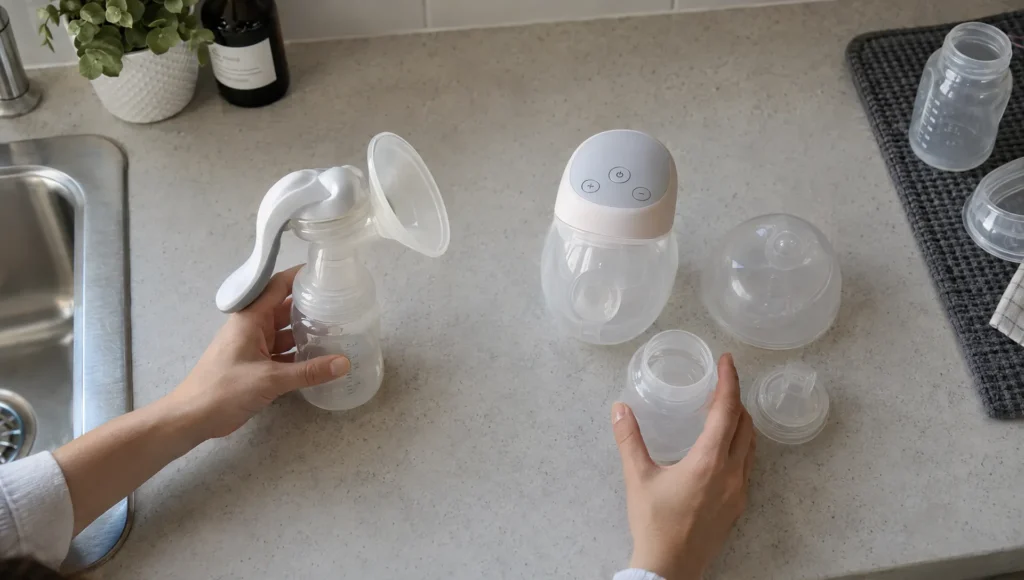
A manual breast pump uses a hand-operated lever to create suction. You control the pace and pressure by squeezing and releasing it, usually expressing from one breast at a time.
There is no motor to charge and no socket to find. That makes a manual pump useful for occasional sessions, travel or keeping as a backup. The trade-off is that your hand does the work throughout the session.
Electric pumps provide the pumping rhythm
An electric pump uses a motor to create suction. Depending on the model, you can adjust its rhythm, suction level or mode. Some run from mains power, while others use rechargeable batteries.
Electric does not automatically mean hands-free. Traditional designs may need a pumping bra to hold the collection parts in place. Wearable models sit inside a suitable bra.
Hand expression is another option. The NHS guide to expressing breast milk explains expressing by hand as well as using pumps.
Your manual vs electric breast pump comparison at a glance
The biggest differences concern effort, portability and how often you expect to express. Neither type guarantees greater comfort or more milk.
| Factor | Manual pump | Electric pump |
|---|---|---|
| Physical effort | Requires repeated hand movements | Motor provides the pumping action |
| Suction control | Adjusted through your hand movements | Adjusted using the available settings |
| Power | No electricity required | Needs mains power, batteries or charging |
| Portability | Usually compact and easy to carry | Varies between standard and wearable designs |
| Noise | No motor noise | Motor noise varies by model |
| Expressing both breasts | Usually one breast at a time | Double models allow simultaneous expressing |
| Purchase cost | Often lower upfront | Often higher, depending on the model |
| Cleaning | Milk-contact parts need cleaning | Milk-contact parts need cleaning, with additional motor-care instructions |
Compare ongoing costs too. Valves, seals, collection containers and other parts may need replacing. Check their availability before buying either type.
A pump that is affordable to buy but difficult to maintain may be less convenient over time.
Which option fits your expressing routine?
Occasional expressing can suit a manual pump
For occasional use, the manual vs electric breast pump choice often comes down to whether hand-operated sessions feel manageable.
If you want to express for an occasional bottle or keep a pump for unexpected changes of plan, a manual model may be sufficient. Its simplicity can outweigh the convenience of a motor.
It is also a reasonable starting point when you do not yet know how often you will express. You can reassess once your routine becomes clearer.
Regular sessions can make electric pumping more practical
If you expect to express regularly, reducing repetitive hand movements may matter more. An electric pump handles that part of the session, although setup, positioning and cleaning still take time.
For returning to work, think about the whole break rather than pumping alone. You need somewhere suitable to express, transfer milk and manage used parts. Our guide to how pumping works around a working day can help you consider those practicalities.
Ask your employer about privacy, breaks, milk storage and charging rather than assuming facilities or equipment will be provided.
Frequent expressing needs a sustainable setup
For several sessions each day, the manual vs electric breast pump decision becomes more about repeatable comfort and workload. A double electric pump may save time by expressing both breasts together.
If you plan to express exclusively, consider how the pump performs for you across your routine, not just whether it fits inside a bra. Our guide to hands-free pumps and exclusive pumping explores that distinction.
A midwife, health visitor or lactation consultant can help you plan a suitable approach, particularly if your baby cannot feed directly at the breast.
Which electric pump design should you consider?
Standard and wearable pumps offer different conveniences
A standard electric pump usually has separate collection parts connected to a motor, often through tubing. Some are portable; others are more suited to a fixed spot.
A wearable breast pump holds its collection assembly inside your bra. A hands-free electric breast pump can be useful when you want your hands available, but it still needs careful positioning. Follow its guidance on movement and avoid assuming it will remain leak-free when bending or lying down.
Single pumps express one breast at a time. Double pumps allow both breasts to be expressed together. Check what is included rather than assuming every electric package contains two pumps.
Loan and hire pumps may be available
Ask your maternity or neonatal team whether suitable loan or hire pumps are available locally. Access and eligibility vary.
Do not treat the term “hospital-grade” as permission to share a pump. Only share equipment explicitly designed by its manufacturer for multiple users, using the required individual accessories.
What makes either pump comfortable to use?
Comfort deserves its own place in a manual vs electric breast pump comparison. A motor does not fix an unsuitable fit, and direct hand control does not guarantee a comfortable session.
The flange is the part that sits against your breast and surrounds your nipple. Check the fit guidance for your chosen pump. Our guide to measuring breast pump flange size at home explains where to start.
Begin gently rather than choosing the strongest available suction. If expressing hurts, stop and check positioning, fit and settings. Seek support from a midwife, health visitor or lactation consultant if discomfort continues or you have feeding concerns.
Think about your hands and posture too. Repeated squeezing may be tiring with a manual pump, while holding traditional electric collection parts can also become uncomfortable. A wearable needs a supportive bra that does not press excessively against your breasts.
What should you check before buying?
Include cleaning and spare parts in your decision
Whichever side of the manual vs electric breast pump comparison suits you, cleaning remains part of every routine. A motor does not remove that task.
Clean milk-contact parts after each use and sterilise them according to NHS guidance and the manufacturer’s instructions. Keep electrical components out of water unless the instructions specifically allow otherwise.
Check how many parts need dismantling, whether replacements are available and how everything will dry between sessions. For battery-powered models, consider where charging will fit into your day.
Look beyond an easy checkout
A smooth shopping experience is helpful, but it is not evidence that a pump will suit you. Your purchase still needs clear information about fit, maintenance, warranty terms and returns.
O&K MUBY offers three wearable electric models: MUBY PRO, MUBY FLOW and MUBY THERMO. The range uses BPA-free materials, is UKCA certified and comes with a one-year warranty.
Use the MUBY PRO, FLOW and THERMO comparison to check model-specific differences. Do not assume every model has identical battery or heating features. Check hygiene-related return restrictions before opening any pump.
Choose the pump that fits your day
The manual vs electric breast pump decision can stay simple: consider how often you expect to express, how much hand-operated effort feels manageable and where sessions will happen.
Choose manual if occasional use, simplicity and freedom from charging matter most. Consider electric if regular sessions or reducing physical effort are higher priorities. A wearable may suit you when keeping your hands available matters too.
If electric sounds right, explore the O&K MUBY breast pumps collection and compare the details against your routine. There is no need to buy more pump than you need.
Frequently asked questions
Do you get more milk with a manual or electric breast pump?
Neither type produces more for everyone. In a manual vs electric breast pump comparison, individual comfort, fit, timing and response matter. If output worries you, discuss your feeding situation with a midwife, health visitor or lactation consultant rather than judging the pump from one session.
Is a manual pump enough as my only pump?
It can be, especially for occasional expressing. If sessions become frequent, long or tiring, an electric option may be more practical. You do not have to decide your entire pumping routine before your baby arrives.
Is an electric pump less painful?
Not necessarily. Either type can be uncomfortable if the fit, positioning or suction is unsuitable. Pumping should not be something you push through despite pain. Stop, reassess and get support if needed.
Is it worth keeping a manual pump as a backup?
It can be useful if you regularly express and want an option that does not need charging. However, a second pump is an extra purchase, not an essential item for every mum. Consider whether you would actually use it.
💙 Keep Pumping Simple with O&K MUBY
Thoughtfully designed wearable breast pumps to fit into your daily routine.
Shop O&K MUBY Breast Pumps