
No products in the cart.

What to Know Before Flying With a Wearable Pump From the UK

Flying with a wearable pump from the UK involves more than charging it before departure. You need to check your airline’s battery and baggage rules, understand how airport security handles expressed breast milk and plan where you will express, transfer milk and clean equipment during the journey.
Keep your pump accessible in your cabin bag, check milk-screening rules for every airport on your route and pack for delays. A little preparation matters most when a short flight becomes a much longer stretch between leaving home and reaching a fridge.
💙 Keep Pumping Simple with O&K MUBY
Thoughtfully designed wearable breast pumps to fit into your daily routine.
Shop O&K MUBY Breast PumpsCheck your airline’s rules before packing
Batteries, charging and cabin baggage
Check your pump’s instructions for its battery type, capacity and transport requirements. The UK government’s guidance on electronic devices in hand luggage is a useful starting point, but your airline’s requirements also apply.
Carry your wearable pump in hand luggage so it remains accessible and is less exposed to loss or damage. Spare lithium batteries and power banks must travel in the cabin, with terminals protected against short circuits. Airlines may also restrict power-bank use and charging during the flight.
If staff need to put your cabin bag in the hold at the gate, tell them about its battery-powered contents and remove any items that must remain in the cabin.
Do not rely on aircraft USB sockets. Charge before leaving home and check whether your particular model can operate while charging rather than assuming it can.
Baggage allowance and onboard use
Ask whether your pump bag counts towards your cabin allowance. A breast pump does not automatically qualify for an additional free bag on every airline.
Also ask about onboard use, particularly on a long-haul journey. Follow crew instructions about electronic devices, stowing equipment and keeping your seat belt fastened. A quiet motor can make expressing less noticeable, but it does not guarantee complete privacy in a shared cabin.
Know the UK airport rules for expressed breast milk
Your wearable pump and the milk you carry are separate security considerations. The device is electrical equipment; expressed milk falls under specific liquid-screening guidance.
According to the UK government’s baby food and baby milk guidance, you can carry breast milk in hand luggage even when your baby is not travelling with you. Its published rules also state that individual containers must hold no more than 2,000 ml and that frozen breast milk cannot be carried in hand luggage.
| Item | What to plan for at a UK departure airport |
|---|---|
| Expressed breast milk | Present it for screening, including when travelling without your baby |
| Milk containers | Follow the published maximum of 2,000 ml per individual container |
| Frozen breast milk | GOV.UK states that this is not permitted in hand luggage |
| Cooling gel packs | These are listed as permitted, but check your airport’s presentation instructions |
| Pump and charging equipment | Pack accessibly and follow security staff’s instructions |
Each milk container needs screening and staff may need to open it. Pack bottles where you can remove them without unpacking your whole bag, and tell security staff what you are carrying before screening begins.
Check your departure airport’s latest instructions shortly before travelling. Different screening equipment does not mean you should assume that every liquid restriction has disappeared. The expressed-milk exemption also does not automatically extend to drinking water or other liquids.
Pack for delays as well as the scheduled flight
Build your kit around the time from your last comfortable expression at home to your next reliable opportunity at your destination. Include airport queues, boarding, connections and the journey after landing.
A wearable pump is more useful when its supporting kit is within reach, rather than buried in an overhead suitcase.
- Expression equipment: Your charged pump, correctly sized flanges or inserts and any essential spare valves or membranes.
- Clean replacement parts: Enough clean, dry milk-contact sets for the sessions you expect, with contingency for disruption.
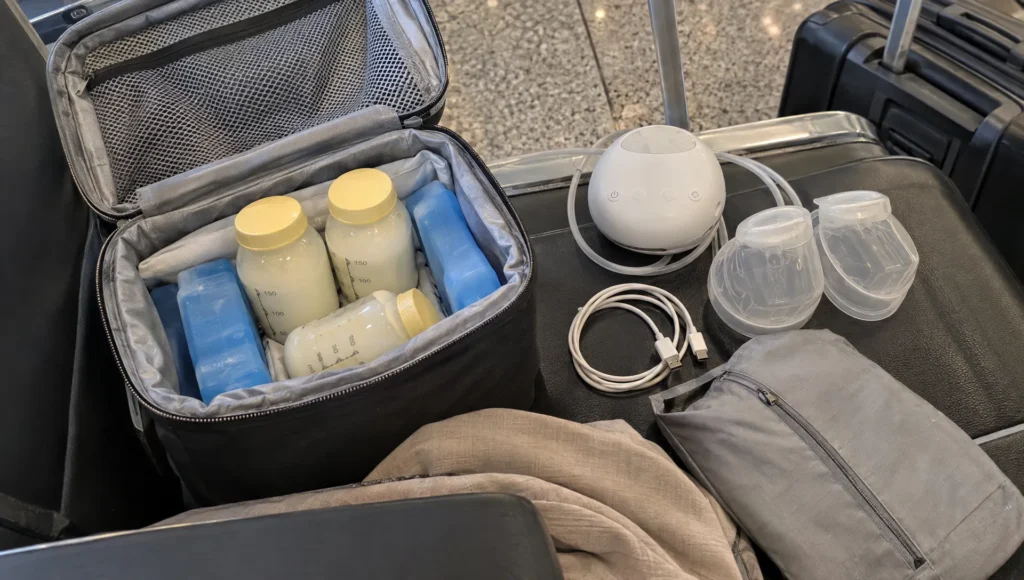
- Milk storage: Leak-resistant containers, labels, an insulated cool bag and suitable cooling packs.
- Separation and hygiene: A clean storage container, a separate bag for used parts and supplies for cleaning your hands.
- Backup: A familiar manual pump or knowledge of hand expression if charging, fit or equipment becomes a problem.
Keep essential medicines, travel documents and feeding supplies accessible too. Our guide to pumping on the go covers the everyday preparation that supports this travel kit.
Test the complete setup before departure, including pouring milk from the collection cups into your chosen bottles. Discovering that a lid leaks or a replacement valve does not fit is much easier to manage at home.
Using a wearable pump comfortably on the plane
Plan around opportunities, not a perfect timetable
Where possible, express before boarding so a queue, delayed departure or extended seat-belt period does not immediately disrupt your routine. Ask airport staff whether a feeding room or another suitable space is available, without assuming every terminal has one.
On board, aim to follow your usual feeding or expressing pattern as closely as practical. There is no single flight schedule that suits everyone, particularly if you are exclusively expressing or establishing milk production.
Try your wearable pump while sitting in a similar upright position before you travel. A bra that works comfortably when standing may press differently against the cups in a narrow aircraft seat.
Check fit and posture
Centre your nipple in the flange tunnel and start at a comfortable suction setting. Persistent rubbing, pinching, blanching or swelling suggests that fit or settings need attention. Increasing suction is not a reliable solution to poor milk flow.
Stay upright unless your model’s instructions specifically allow another position. Our guidance on bending or lying down with a hands-free pump explains why posture can affect seals and leaks.
Wait until the aircraft is steady before removing cups or pouring milk. Keep lids ready, avoid filling beyond the stated capacity and pause handling if turbulence makes transfer unsafe. Your seat belt must remain positioned as the crew instructs, not adjusted around the pump in a way that compromises it.
Keep expressed milk cold throughout the journey
A wearable pump collects milk; it does not refrigerate it. Your storage plan needs to cover the airport, flight, connections and onward journey, not just time in the air.
The NHS guidance on expressing and storing breast milk says milk that has been cooled in the fridge can be carried in a cool bag with ice packs for up to 24 hours. That advice is not a guarantee for a bag left open in a warm terminal or for milk that was never properly chilled.
Start with pre-chilled milk and adequately frozen cooling packs. Keep the bag closed as much as possible, protect it from heat and consider a thermometer to help you monitor conditions. Aim to maintain refrigerator-like temperatures, ideally 4°C or below.
Label containers with the expression date and time. When crossing time zones, use one consistent time reference or record elapsed time so you do not accidentally extend storage limits.
For milk expressed during travel, use clean containers and cool it promptly. Cool freshly expressed milk before combining it with already chilled milk, and base storage decisions on the oldest milk in the container.
Do not rely on cabin crew being able to refrigerate your milk or refreeze cooling packs. If the journey exceeds your reliable cooling arrangements, plan another safe feeding and storage option before departure. Seek individual advice for premature or medically vulnerable babies, whose care teams may recommend stricter handling.
Plan how to clean parts between sessions
An aircraft lavatory is a cramped place to wash equipment, and you should not assume its tap water is suitable for cleaning milk-contact parts. Carrying additional clean sets is often more practical than trying to complete the whole process during a flight.
After using your wearable pump, separate the milk-contact components as directed by the manufacturer. Keep used parts apart from clean equipment and wash them properly as soon as practical. A quick wipe is not equivalent to thorough cleaning.
Clean milk-contact parts after each use and follow the manufacturer’s instructions for an appropriate sterilising method. Check which components tolerate steam, boiling or cold-water sterilising solutions before travel. Never immerse a motor or electronic unit unless the instructions explicitly permit it.
Wash your hands before assembling equipment or transferring milk. If handwashing facilities are temporarily unavailable, hand sanitiser can help with hand hygiene, but it does not clean pump parts or replace proper washing when hands are visibly dirty.
Allow washed parts to air-dry fully in a clean area before packing them away. Do not assume that simply refrigerating used parts makes them ready for another session, especially when expressing for a very young, premature or immunocompromised baby.
Check connections, accommodation and the return journey
Rules at your UK departure airport do not determine what happens at an overseas connection or on the way home. Check each airport’s milk and cooling-pack rules, along with any relevant destination customs or biosecurity requirements.
For a long journey, your wearable pump also needs to fit the arrival plan. Ask your accommodation whether you will have a reliable fridge, access to a freezer for cooling packs and a suitable place to wash and sterilise equipment. A minibar may not maintain the temperature you need.
Check charger voltage compatibility as well as plug shape. A travel adaptor changes the connection, not necessarily the electrical supply your charger can accept.
For longer family visits, save local healthcare contacts with your accommodation details. Keep appropriate breastfeeding-support contacts separately so you know where to turn for expressing difficulties.
If you depend on frequent or exclusive expressing, test whether your usual setup maintains comfortable, effective milk removal before relying on it abroad. Some people need a different pump for certain sessions. Take a backup you know how to use rather than trying unfamiliar equipment after a delay.
Choose your setup before departure
The most useful travel setup is one you have already tested for comfort, milk removal, battery life and cleaning. If you are comparing options, explore the O&K MUBY pump collection and check each model’s specifications and instructions against your journey. Leave time for a practice run before relying on a new pump at the airport.
Frequently Asked Questions
Can I take expressed breast milk through UK security without my baby?
Yes. GOV.UK says breast milk can be carried in hand luggage without your baby travelling with you. Individual containers must hold no more than 2,000 ml and each needs screening. Check the airport’s instructions before departure.
Can I take frozen breast milk in my cabin bag?
GOV.UK’s published guidance says frozen breast milk cannot be taken in hand luggage. Do not assume that permission for cooling gel packs also covers frozen milk. Check separate arrangements with your airline if you need to transport a frozen supply.
Can I use a wearable pump during a flight?
Check with your airline and follow crew instructions. Plan for upright seating, comfortable flange alignment and safe milk transfer. There may be periods when handling equipment is impractical, particularly during boarding, turbulence or landing.
Does a breast pump qualify for free extra hand luggage?
Not automatically. Airlines set their own baggage policies and may have specific processes for medical equipment. Ask about your pump and its accessories before travelling, and keep written confirmation if an additional allowance is agreed.
What if I cannot express when planned?
Express or feed when safely possible. Hand expression or a familiar manual pump may help if your electric setup is unavailable. Seek medical advice promptly if you develop a hot, painful breast area, fever or feel unwell.
💙 Keep Pumping Simple with O&K MUBY
Thoughtfully designed wearable breast pumps to fit into your daily routine.
Shop O&K MUBY Breast Pumps