
No products in the cart.

Can a Hands Free Breastfeeding Pump Help With Exclusive Pumping?

Using a breastfeeding pump hands free can make exclusive pumping more manageable, especially when you are expressing several times a day. Yes, a hands-free pump can help, but it needs to remove milk effectively and comfortably, not simply fit neatly inside your bra.
Some mums use a wearable pump for every session. Others get better results by combining one with a separate double electric pump. The right arrangement depends on your stage after birth, milk supply, comfort and how your baby is growing. Here is how to assess whether a hands-free setup can support your feeding goals without adding avoidable stress.
💙 Keep Pumping Simple with O&K MUBY
Thoughtfully designed wearable breast pumps to fit into your daily routine.
Shop O&K MUBY Breast PumpsWhat exclusive pumping needs from any pump
Exclusive pumping means expressing breast milk for your baby rather than feeding directly at the breast. You may use an electric pump, hand expression or a combination. The milk still needs to be collected, stored and offered to your baby, so pumping is only one part of the workload.
Milk production responds to frequent, effective milk removal. A pump that is convenient but regularly leaves your breasts uncomfortably full may not meet your needs as your main pump. Equally, a powerful pump that hurts or is difficult to use regularly is not a good solution.
In the early weeks, a common starting point is around eight to twelve expressions over 24 hours, including overnight. This is not a permanent timetable for everyone. Ask your midwife or an infant feeding specialist to help you plan, particularly if your baby is premature, unwell or not gaining weight as expected.
Can using a breastfeeding pump hands free work for every session?
It can, provided the pump suits you and supports enough milk removal across the day. There is no single design that works best for every breast shape, milk supply or stage of feeding.
It also helps to distinguish hands-free from wearable. A traditional double electric pump can be used hands-free with a suitable pumping bra. A wearable pump collects milk inside your bra, sometimes with a separate motor or controller. Neither label tells you how well a particular pump will work for you.
A wearable may be a reasonable main option if expressing is comfortable, your breasts soften after sessions and your overall output meets your baby’s needs. If supply is still being established, arrange early support rather than assuming any wearable will be suitable as your only pump.
A midwife or lactation specialist may recommend a hospital-supplied double electric pump in some circumstances. That is an individual recommendation, not a rule that everyone who exclusively pumps must hire one.
Check comfort and milk removal before committing
Start with flange fit and positioning
Before relying on a breastfeeding pump hands free for every session, check how your nipple moves inside the flange tunnel. It should be centred and able to move without rubbing painfully against the sides. Pinching, blanching, cracks or marked swelling suggest that fit, positioning or suction needs attention.
A bra should hold the collection cups securely without pressing them hard into your breasts. Too much compression can make an otherwise suitable pump uncomfortable. Check alignment before switching on, then check again once suction begins.
Start at a low setting and increase only to a comfortable level. Stronger suction does not automatically mean more milk. Persistent pain is a reason to stop and assess the problem, not something you need to tolerate to maintain supply.
Flange requirements can differ between breasts and may change over time. Follow the manufacturer’s fitting guidance and seek help if adjustments do not resolve discomfort.
Look at patterns, not one bottle
Milk volume varies with the time of day, the gap since your last session and many other factors. One smaller collection does not prove that a pump is ineffective or that your supply has fallen.
When trying a new setup, note session times, approximate volumes and comfort over several days. Compare broadly similar sessions rather than expecting identical results every time. Breast softening can be useful feedback, but it is not a precise measurement of milk removal.
If using a breastfeeding pump hands free consistently produces less milk than your usual setup, alongside fullness or a falling daily total, investigate promptly. Check assembly, seals, valves, fit and charging before increasing suction or extending every session.
Your baby’s wellbeing matters more than a pump display. The NHS guidance on getting enough milk explains signs such as wet nappies and weight gain. Ask your midwife or health visitor to interpret these for your baby’s age and circumstances.
Introduce it without replacing everything at once
If you already have an effective pumping routine, try the wearable for one or two sessions before switching completely. Keep the rest of your routine reasonably consistent so you can judge the change.
There is no need to continue a trial that causes pain or leaves you persistently uncomfortable. A wearable can still be useful for selected sessions even if it is not your best option for the whole day.
Build a routine around milk removal, not multitasking
The practical value of a hands-free pump is often that it makes a planned session easier to keep. It should not make pumping so invisible that sessions are repeatedly delayed, interrupted or forgotten.
If you use a breastfeeding pump hands free throughout the day, plan where cleaning, charging and milk storage will happen as well as when you will express. A charged motor is not enough if every collection cup is waiting to be washed.
| Part of the routine | What to plan | What to watch for |
|---|---|---|
| Regular sessions | A pattern suited to your stage and feeding goals | Repeatedly missed sessions or uncomfortable fullness |
| Overnight expressing | Support with feeds and cleaning where possible | Lengthening gaps before supply is established |
| Leaving home | Clean parts, battery charge and suitable milk storage | No hygienic place to transfer or cool milk |
| Equipment problems | A backup method you know how to use | Being unable to express when a part fails |
Light, upright activities may be practical if your pump’s instructions allow them. Bending, vigorous movement or carrying your baby against the cups may disturb the seal or cause leaks. Hands-free does not mean suitable for every task.
Use the manufacturer’s session guidance as a starting point and adjust with feeding support if needed. Breasts continually make milk, so chasing a completely “empty” feeling with prolonged sessions can cause soreness without solving the underlying issue.
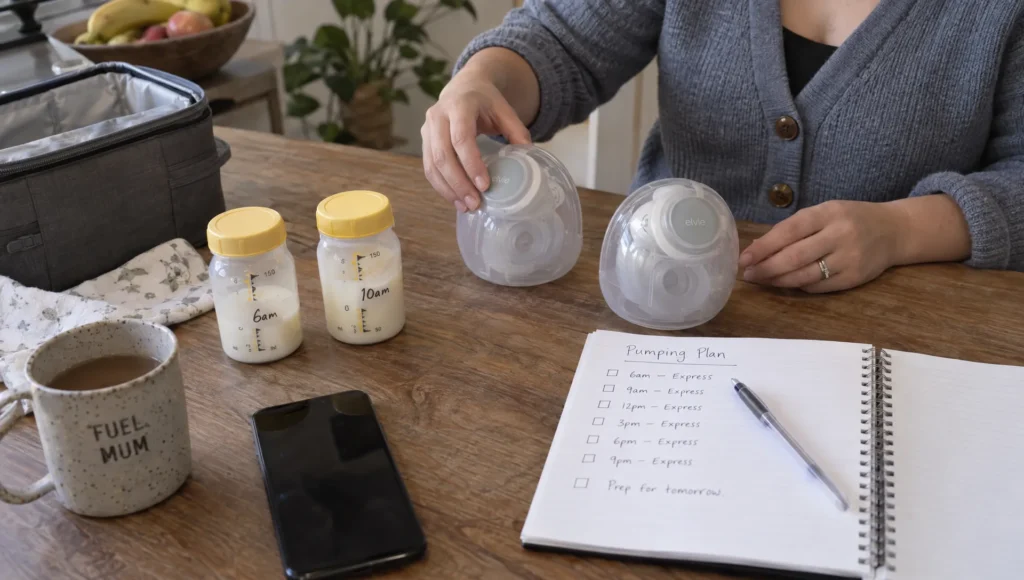
Account for cleaning, storage and backup equipment
A wearable removes the need to hold bottles during expression, but it does not remove the work afterwards. Collection cups, membranes and valves need careful handling. Milk residue or an incorrectly fitted part can affect hygiene or pump performance.
Wash your hands before expressing and clean milk-contact parts after use. Follow the manufacturer’s instructions for washing, sterilising and drying each component. Electrical parts should not be immersed unless their instructions explicitly allow it.
Using a breastfeeding pump hands free also means planning how to transfer milk without spills and how to cool it promptly when away from home. The NHS guide to expressing and storing breast milk covers storage times and safe handling. Follow your neonatal team’s advice if your baby is premature or unwell, as requirements may differ.
For exclusive pumping, a backup is worth considering. This might be another pump or knowing how to hand express. The aim is to avoid being unable to remove milk because a battery is flat or an essential part is damaged.
Know when to change the plan or seek support
A sudden drop in output does not always mean your supply has permanently fallen. Check for worn valves, poor assembly, a lost seal or a change in fit. If the problem continues, get feeding support rather than repeatedly turning up suction.
Stop and reassess if sessions cause nipple injury, increasing swelling or persistent breast pain. If expressing with a breastfeeding pump hands free is consistently less comfortable or effective than another method, use the method that works while you seek advice.
A hot, painful area of breast, redness, fever or flu-like symptoms can indicate mastitis. The NHS mastitis guidance explains self-care and when to contact a GP. Avoid forceful massage and pumping extra simply to try to “clear” the breast.
If your baby has fewer wet nappies than expected, is unusually sleepy, feeds poorly or is not gaining weight as expected, seek prompt advice from your midwife, health visitor or GP. Do not wait for several days of pump comparisons.
Choose features that support repeated daily use
For exclusive pumping, daily usability deserves as much attention as discretion. Check the available flange sizes, how easily parts come apart, whether replacement components are available and what the battery specification means for your routine. Auto shut-off is a useful safeguard, not a personalised recommendation for session length.
O&K MUBY offers three hands-free wearable models with quiet motor technology, BPA-free materials, UKCA certification and a one-year warranty. Settings, battery specifications and heating features vary by model, so check the details of the pump you are considering.
For example, the MUBY FLOW’s four modes and nine suction levels provide different settings to try. Those options do not guarantee higher output; comfortable fit and effective milk removal remain the deciding factors.
Before choosing a breastfeeding pump hands free for daily exclusive use, compare practical requirements rather than assuming the model with the most settings will suit you best. Our guide to choosing a breast pump for your feeding goals can help you assess the wider options.
Find a setup you can use consistently
The best exclusive-pumping setup is one that removes milk comfortably and fits a routine you can sustain. A wearable can be your main pump or a useful addition, without having to do every job.
Explore the O&K MUBY hands-free pump collection to compare models, then choose around fit, repeated daily use and your feeding needs. If comfort, supply or your baby’s intake is uncertain, get feeding support alongside that decision.
Frequently asked questions
Can I exclusively pump with only a wearable pump?
Yes, some mums can. It needs to be comfortable, remove milk effectively and support your baby’s intake. If you are establishing supply or seeing a drop in output, seek individual advice before depending on it for every session.
Will a hands-free pump increase my milk supply?
Not automatically. It may help you keep regular sessions that would otherwise be missed. Supply depends on effective milk removal and individual factors, not on whether the pump is wearable. Increasing suction or session length is not always the answer.
Is a hands-free pump worth it for exclusive pumping?
It can be worthwhile if it reduces the practical burden without compromising comfort or output. Using a breastfeeding pump hands free for selected sessions may offer enough flexibility; you do not have to use the same pump all day to benefit.
Can I express milk with my hands instead?
Yes. Hand expression is a useful skill for collecting colostrum, relieving fullness and managing unexpected equipment problems. If you plan to use it as your main method, ask for support with technique and a routine that meets your baby’s needs.
Do I need a second pump?
Not necessarily, but you need a workable backup plan. Some mums combine a wearable with another electric pump, while others keep a manual pump or use hand expression. Choose around reliability, comfort and your circumstances.
💙 Keep Pumping Simple with O&K MUBY
Thoughtfully designed wearable breast pumps to fit into your daily routine.
Shop O&K MUBY Breast Pumps